How to Talk to Children About Personal Safety: A Practical Guide for Parents and Caregivers

Talking to children about personal safety is one of the most protective things a caregiver can do. Research consistently shows that children who receive clear, calm guidance about body autonomy, safe and unsafe touch, and trusted adults are better equipped to recognize danger, speak up, and seek help. This guide gives you practical language and strategies you can start using today.
Why These Conversations Cannot Wait
Personal safety conversations are prevention tools, not crisis responses. Waiting until something goes wrong — or until a child "seems old enough" — misses the window when these lessons are most easily absorbed and most urgently needed.
Statistics from child protection organizations indicate that most abuse is perpetrated by someone the child knows, often someone trusted by the family. That reality makes early, normalized conversations essential. When children already have a framework for understanding body ownership, safe versus unsafe touch, and who their trusted adults are, they are more likely to recognize a problem and more likely to disclose it.
The goal is not to frighten children. The goal is to give them language, confidence, and a clear path to safety. Think of these conversations the way you think about teaching road safety — you don't avoid the topic because cars are dangerous. You teach children to look both ways, and you repeat it until it's automatic.
Start With Body Autonomy and Correct Vocabulary
Body autonomy — the principle that a child's body belongs to them — is the foundation of every personal safety conversation. When children understand they have ownership over their own bodies, concepts like consent and safe touch follow naturally.
A critical part of this foundation is using anatomically correct language for private parts. Words like "penis," "vulva," and "buttocks" should be used the same way children learn to say "elbow" or "knee." This matters for several reasons:
- It removes shame and secrecy from body-related conversations, making children more comfortable speaking up.
- If a child ever needs to report abuse, using correct terminology makes their account clearer and more credible to teachers, doctors, and authorities.
- It signals to children that these body parts are not shameful or taboo — just parts of the body with names, like any other.
A simple starting point: "Your body belongs to you. No one should touch your private parts — the parts covered by your swimsuit — except to keep you clean and healthy, like a doctor with a parent present."
Teaching the Difference Between Safe and Unsafe Touch
Children can understand safe and unsafe touch from a young age when the concept is explained in concrete, child-friendly terms. Safe touch includes hugs from family members a child is comfortable with, a doctor's examination with a parent present, and a friend holding hands. Unsafe touch involves contact with private parts outside of necessary care, or any touch that feels wrong, confusing, or secret.
Two points deserve special emphasis:
Secrets about touch are never okay. Many grooming behaviors rely on secrecy. Teaching children early that no trusted adult will ever ask them to keep a touch secret gives them a clear red flag to watch for. You can explain it this way: "Surprises are okay — like a birthday present. But secrets about touching your body are never okay. You can always tell me."
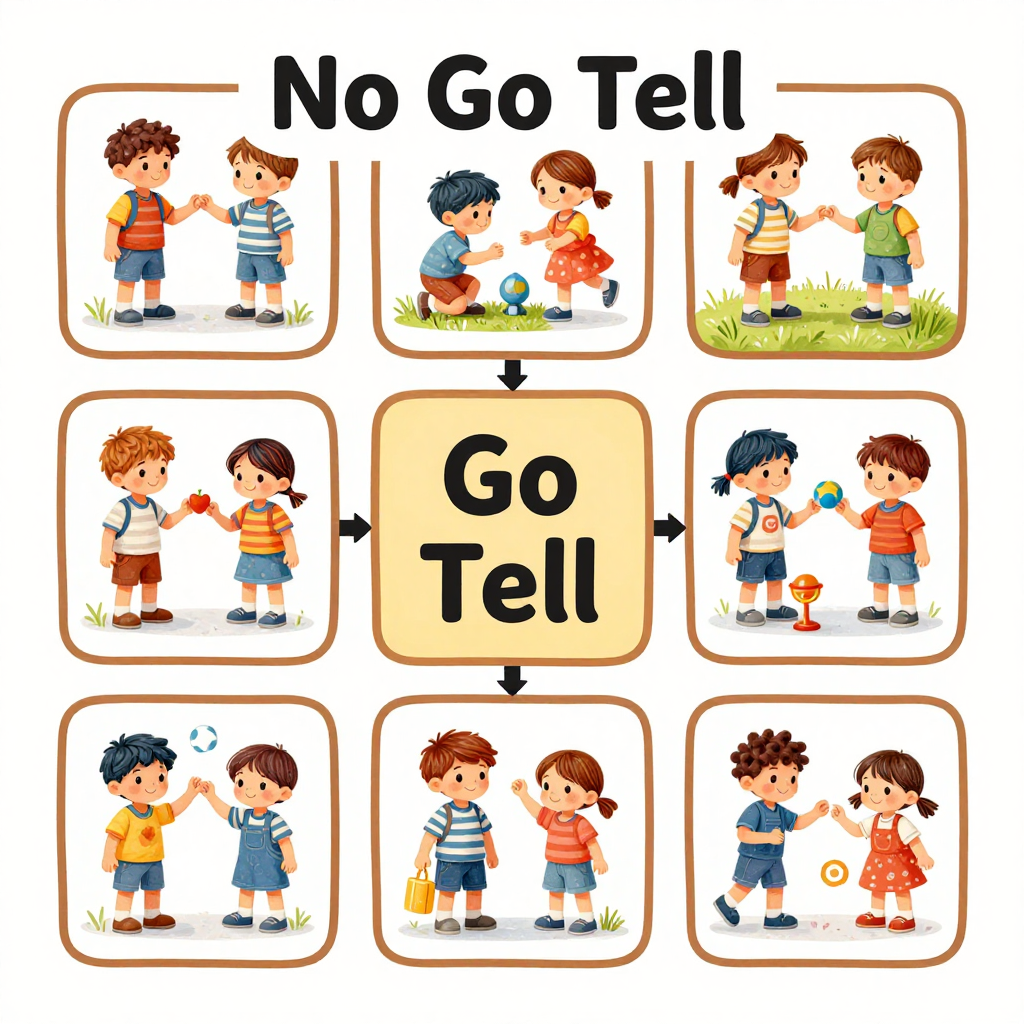
The "No, Go, Tell" safety rule is a simple, memorable framework many child protection programs use. If someone touches you in a way that feels unsafe: say No, Go away from that person, and Tell a trusted adult. Practicing this out loud with children — even role-playing it — builds confidence so the response feels natural under stress.
Age-Appropriate Approaches: Toddlers Through Teens
The depth and language of safety conversations should evolve as children grow. What works for a three-year-old is not sufficient for a twelve-year-old, and what's appropriate for a teenager requires a different kind of honesty.
Toddlers and Preschoolers (Ages 2–5)
Focus on body ownership and correct vocabulary. Teach the names of private parts during bath time. Practice "No" as a complete sentence. Establish that no one touches their body without permission, and that they can always tell a safe adult if something feels wrong.
School-Age Children (Ages 6–12)
Introduce the concept of grooming behaviors in age-appropriate terms — adults who ask for secrets, give lots of special gifts, or want to spend time alone in private. Reinforce the No, Go, Tell rule. Begin conversations about online safety: private information online is the same as private parts of the body — not for sharing with strangers.
Adolescents (Ages 13+)
Shift toward explicit conversations about consent, peer pressure, and digital safety. Teenagers need to understand that consent must be freely given, ongoing, and can be withdrawn at any time. Discuss what healthy relationships look like versus controlling or manipulative ones. Online safety at this age includes sexting risks, image-sharing without consent, and recognizing online grooming.
Identifying and Naming a Circle of Trusted Adults
Every child needs a concrete, named list of adults they can go to if something feels wrong. Research in child protection consistently shows that children are more likely to disclose abuse when they have identified safe people in advance — not just a vague instruction to "tell a grown-up."
Help your child identify three to five trusted adults across different settings: a parent or guardian, a grandparent, a teacher, a school counselor, a neighbor they know well. The key criteria: this person listens without judgment, believes the child, and will take action to help.
Practice the conversation: "If something happened that made you feel scared, confused, or unsafe, who are the people you could tell? Let's name them together." Writing or drawing these people can make the concept more concrete for younger children.
Reinforce that if one trusted adult doesn't respond the way the child needs, they should keep telling until someone helps. This counters the discouragement many children feel if a first disclosure is met with disbelief or inaction.
How to Keep the Conversation Going — Not Just Have It Once
Personal safety is an ongoing conversation, not a single uncomfortable talk. One discussion, however thorough, is not enough. Children need repeated, low-pressure exposure to these concepts to internalize them.
The good news: everyday life offers natural entry points. A few examples:
- Bath time with young children is a natural moment to name body parts and reinforce body ownership.
- News stories or TV moments (handled age-appropriately) can prompt: "What would you do if something like that happened?"
- After school check-ins — "Did anything happen today that made you feel uncomfortable or confused?" — normalize the question so it doesn't feel alarming when asked.
- Before playdates or sleepovers is a good time to briefly remind children of the No, Go, Tell rule and who to call if they need you.
Open-door communication — the consistent message that your child can come to you with anything, without fear of anger or disbelief — is itself a protective factor. Children who believe their caregiver will listen are significantly more likely to disclose early, when intervention is most effective.
What to Do If a Child Discloses Abuse or Unsafe Situations
If a child tells you something concerning, your immediate response shapes whether they continue talking or shut down. Stay calm, believe the child, and keep your reaction measured — even if what you're hearing is alarming.
A few principles to follow in the moment:
- Believe and validate: "Thank you for telling me. I believe you, and this is not your fault."
- Don't press for details: Asking leading questions can inadvertently distress the child or complicate a later investigation. Let them share what they're ready to share.
- Don't promise secrecy: Be honest: "I'm going to need to tell someone who can help keep you safe."
- Contact appropriate support: Depending on your location, this may mean calling child protective services, a child advocacy center, or law enforcement. In the US, the Child Welfare Information Gateway provides state-by-state reporting resources.
Your calm, believing response is one of the most powerful things you can offer a child in that moment. It doesn't have to be perfect. It just has to be present.
Frequently Asked Questions
At what age should I start talking to my child about personal safety?
Start as early as age two or three, using simple language about body ownership and correct vocabulary for body parts. Safety concepts can be introduced gradually and built upon as children grow.
What if my child seems embarrassed or refuses to engage?
Normalize the discomfort without forcing the conversation. Try a lighter touch — a book, a car ride where there's no eye contact, or a brief mention rather than a formal sit-down. Consistency matters more than any single conversation going perfectly.
How do I explain body safety without scaring my child?
Frame safety conversations around empowerment and knowledge, not fear. Focus on what children can do — name their body parts, say no, tell a trusted adult — rather than on frightening scenarios. The tone you bring to the conversation is as important as the words.
Should I use the correct names for private body parts with young children?
Yes. Using anatomically correct language reduces shame, improves communication, and makes children more credible and understood if they ever need to report something. There is no developmental downside to teaching children accurate vocabulary.
How do I talk about online safety as part of personal safety conversations?
Connect online safety to the same principles: private information (passwords, photos, location) is like a private part of the body — not for sharing with strangers. Teach children that grooming can happen online just as in person, and that they should tell a trusted adult if anyone online makes them feel uncomfortable, asks for photos, or wants to keep the conversation secret.
These conversations are not a single event. They are a relationship — built over years of small moments, consistent messages, and an open door. That consistency is what keeps children safe.